

SMD vs Traditional LED: Complete Comparison
Surface-Mount Device (SMD) LEDs represent a major evolution over traditional LEDs (DIP), particularly in display and signage applications, offering superior integration and performance. This in-depth comparison explores their differences across design, performance, applications, and more — optimized for searches like "SMD vs traditional LED displays pros cons".
Quick navigation
Understanding SMD and Traditional LED Technologies
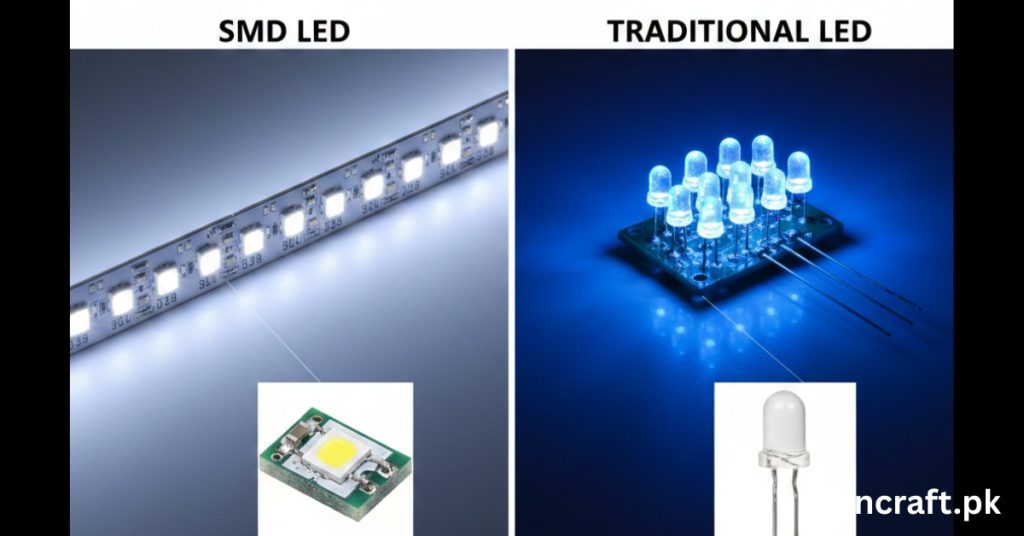
SMD LEDs integrate multiple LED chips (typically red, green, blue) into a single compact package mounted directly onto circuit boards via surface-mount technology. This allows seamless color mixing and high-density arrays ideal for vibrant displays.
Traditional LEDs, or DIP LEDs, feature individual bulb-like structures with leads inserted through holes in PCBs, soldered manually for basic lighting and early displays. While reliable for simple tasks, their bulkier form limits scalability in high-resolution setups. Both convert electricity to light efficiently, but SMD's advancements make it the standard for contemporary signage and screens.
Need expert advice?
Talk to Sign Craft’s LED specialists – free consultation.
Key Design and Construction Differences
The core disparity lies in packaging and mounting. SMD LEDs are flat, chip‑based units without protruding leads, enabling automated assembly and denser packing for finer pixel pitches. Traditional LEDs use cylindrical epoxy lenses with metal pins, requiring through‑hole mounting that increases bulk and assembly time.
| Feature | SMD LED | Traditional LED (DIP) |
|---|---|---|
| Mounting Method | Surface‑mount (SMT) | Through‑hole |
| Physical Form | Compact, flat chip | Bulky, bulb‑shaped with leads |
| Assembly Process | Automated, high‑volume | Manual soldering |
| Pixel Density Potential | High (e.g., P2.5 screens) | Lower, coarser resolution |
| Repairability | Module‑level fixes | Often full‑panel replacement |
Brightness, Color Rendering, and Visual Quality
SMD LEDs excel in output and uniformity. A single SMD 5050 chip can deliver up to 18 lumens, far surpassing traditional 5mm LEDs at around 5 lumens. Integrated RGB chips ensure excellent color mixing, producing millions of hues with minimal hotspots. Traditional LEDs typically emit single colors per unit with narrower beam angles (25‑40°), leading to visible dots in displays.
| Performance Metric | SMD LED Advantage | Traditional LED Limitation |
|---|---|---|
| Luminous Efficacy (lm/watt) | Higher (efficient chips) | Lower (inefficient design) |
| Heat Dissipation | Superior (flat surface) | Requires extra cooling |
| Power per Brightness Level | Reduced consumption | Higher draw |
| Uniformity | No hotspots | Visible dots |
Viewing Angles and Image Consistency
SMD screens provide superior off‑axis viewing, remaining vibrant even at 160°+ horizontally/vertically. This makes them ideal for crowds or dynamic environments like malls and stadiums. Traditional LED displays suffer color shifts and dimming beyond 120°, as individual diodes create discrete light points. SMD's clustered emitters eliminate "grenade" effects (visible LED dots), yielding seamless imagery.
Energy Efficiency and Heat Management
SMD technology consumes less power for equivalent brightness, thanks to optimized chip structures and better thermal contact with boards. Enhanced heat dissipation prevents thermal throttling. Traditional LEDs generate more heat per lumen, often needing bulky heatsinks that add weight. SMD's sealed design resists dust and vibration, boosting reliability.
Durability, Lifespan, and Environmental Resilience
Both offer long lives (50,000+ hours), but SMD edges out with better resistance to environmental stressors. Their compact, sealed form withstands moisture, temperature swings, and vibrations better than exposed‑lead traditional LEDs. Traditional LEDs are robust for low‑stress uses but degrade faster under continuous high‑output operation.
Ideal Applications for Each Technology
SMD LED Strengths
- Indoor/Outdoor Displays: video walls, digital billboards, events
- Signage and Advertising: uniform brightness for storefronts
- Portable VMS: lightweight for traffic/mobile setups
- Architectural Lighting: strips, RGB dynamics
Traditional LED Applications
- Basic Indicators: control panels, status lights
- Legacy Displays: older price signs
- Low‑Power Decor: holiday lights, signals
Comparison Table: SMD vs Traditional LED Displays
| Category | SMD LED Displays | Traditional LED Displays |
|---|---|---|
| Resolution/Detail | Fine pitch, seamless images | Coarser, dot‑matrix visible |
| Color Accuracy | Excellent RGB mixing | Single‑color limited |
| Viewing Angle | Wide (160°+) | Narrower (120°) |
| Brightness Uniformity | High, no hotspots | Moderate, potential dots |
| Weight/Thickness | Lightweight, slim | Heavier, bulkier |
| Energy Use | More efficient | Higher consumption |
| Durability | Vibration/moisture resistant | Basic protection |
| Maintenance | Modular repairs | Complex panel changes |
| Best Use Cases | Video walls, signage, events | Indicators, basic signs |
Sign Craft: Pakistan's Top SMD Screen and LED Display Provider
For cutting‑edge SMD screen installations and LED display services, Sign Craft stands as Pakistan's leading specialist. They deliver bespoke solutions from high‑resolution video walls to dynamic signage, leveraging SMD technology for unmatched clarity and reliability. Explore our services → | Contact us
Common Myths Debunked
- Myth: SMD is just smaller traditional LEDs. Reality: SMD integrates multiple chips for superior mixing/output.
- Myth: Traditional is more durable. Reality: SMD's sealing enhances longevity.
- Myth: No difference in displays. Reality: SMD eliminates visual artifacts.
SMD continues advancing with mini/micro‑LED variants for ultra‑fine pitches (P1.5+), pushing 8K and higher refresh rates. Traditional LEDs persist in niche, low‑spec roles.
FAQs: SMD vs Traditional LED
Explore more insights:
Ready to upgrade your display?
Call Sign Craft now for expert SMD solutions.
Sign Craft | Services | Contact
© 2026 – Pakistan's premier LED & signage provider