

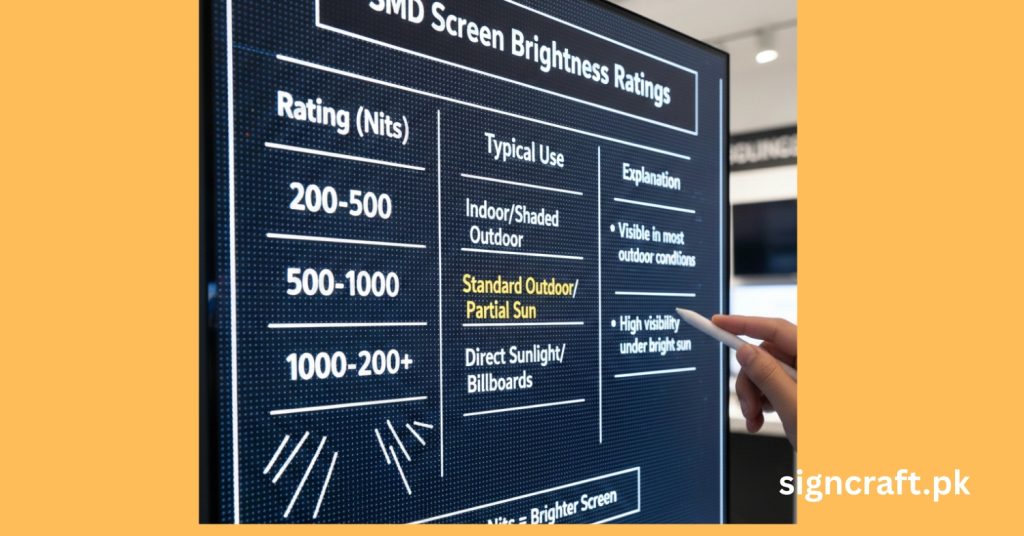
SMD Screen Brightness Ratings Explained
Complete Guide to Understanding Nits, Candelas and Brightness Specifications for LED Displays in Pakistan
Need Expert Advice on SMD Screen Brightness?
Contact Sign Craft Pakistan for professional consultation and premium LED display solutions tailored to your specific needs.
📞 Call or WhatsApp: +92 3008599612
Contact Us Now WhatsApp DirectWhat is SMD Screen Brightness?
In today's digital advertising landscape, SMD (Surface-Mounted Device) screens have revolutionized how businesses communicate with their audiences. From towering outdoor billboards to sleek indoor displays, these LED screens deliver vibrant, eye-catching content that captures attention and drives engagement. However, one of the most critical yet often misunderstood specifications of SMD screens is brightness rating.
Why Brightness Matters
Understanding brightness measurements and their practical implications is essential for selecting the right display for your specific application and environment. At Sign Craft Pakistan, we are Pakistan's leading provider of SMD screens and LED display solutions, delivering cutting-edge technology and expert guidance to businesses across the country. Our comprehensive understanding of display technology helps clients make informed decisions that maximize their investment and ensure optimal visual performance in any setting.
Brightness in LED displays refers to the amount of light emitted by the screen, determining how visible and vibrant the content appears under various lighting conditions. This luminosity is what allows your message to stand out in bright sunlight, remain legible in shaded areas, and create impact in indoor environments.
How Brightness Is Measured: Understanding Nits and Candelas
The measurement of display brightness follows standardized protocols that allow meaningful comparisons between different screens and technologies.
Candela (cd)
Base unit of luminous intensity representing one standard candle
Nit (cd/m²)
One candela per square meter - standard display brightness unit
Lumens
Total light output - different from nits which measure intensity per area
| Measurement Term | Definition | Application in Displays |
|---|---|---|
| Nit (cd/m²) | Luminous intensity per square meter | Primary brightness specification for all LED displays |
| Candela (cd) | Base unit of luminous intensity | Used in calculating nit values and directional brightness |
| Lumens (lm) | Total visible light emitted | More relevant for projectors and light sources, not displays |
Typical Brightness Ranges for Different Applications
SMD screens are deployed in diverse environments, each requiring different brightness levels for optimal performance. Understanding these ranges helps you select appropriate displays for your specific needs.
Indoor Retail & Corporate
Viewing Conditions: Controlled lighting, indirect sunlight
Examples: Shopping malls, corporate lobbies, conference rooms
Indoor High-Ambient
Viewing Conditions: Large windows, significant natural light
Examples: Airports, train stations, bright retail spaces
Semi-Outdoor/Covered
Viewing Conditions: Protected but exposed to daylight
Examples: Covered walkways, building entrances, canopies
Outdoor Standard
Viewing Conditions: Direct sunlight, variable weather
Examples: Roadside billboards, building facades, parking areas
Outdoor High-Brightness
Viewing Conditions: Intense sunlight, competitive environments
Examples: Highway billboards, sports stadiums, direct sun exposure
Unsure About Brightness Requirements?
Our technical team provides free site assessments to determine optimal brightness levels for your specific installation in Pakistan.
📞 Call or WhatsApp: +92 3008599612
Request Site Assessment View Our ServicesFactors That Affect Required Brightness Levels
Selecting the appropriate brightness rating requires careful consideration of multiple environmental and operational factors that influence how your content appears to viewers.
Ambient Light Conditions
The amount of surrounding light is the primary determinant. Outdoor installations face intense sunlight (up to 100,000 lux), while indoor spaces typically range from 300-1,000+ lux.
Viewing Distance & Angle
Distance affects perceived brightness. Screens viewed from 100+ meters require higher brightness than those viewed from 2-5 meters. Viewing angles up to 160° must be considered.
Geographic Location & Climate
Regions closer to the equator experience more intense sunlight. Desert climates require higher brightness than temperate zones. Seasonal variations must be considered.
Screen Orientation
North-facing screens receive less direct sunlight than south-facing installations. East and west-facing screens experience intense morning or afternoon sun exposure.
Content Type & Design
High-contrast content remains legible at lower brightness. Video content may require higher brightness for clarity. Content design should align with display capabilities.
Local Regulations
Many jurisdictions regulate outdoor display brightness to prevent light pollution and minimize driver distraction. Compliance with local ordinances is essential.
The Technology Behind SMD Screen Brightness
Understanding how SMD screens generate brightness helps clarify the relationship between specifications and real-world performance.
| Technology Component | Function | Impact on Brightness |
|---|---|---|
| LED Chip Technology | Fundamental light source using red, green, blue chips | Determines maximum achievable brightness and longevity |
| Pixel Configuration | Arrangement of LEDs in 3-in-1 or discrete configurations | Affects color mixing, uniformity, and light output efficiency |
| Driver IC Systems | Control LED brightness through pulse-width modulation | Enables precise brightness control and flicker-free operation |
| Optical Design | Lens systems and light management components | Directs light efficiently and reduces glare for better visibility |
| Thermal Management | Cooling systems to dissipate heat | Maintains consistent brightness and extends LED lifespan |
Learn More About SMD Technology
Explore our detailed guides on SMD display technology: MicroLED vs Traditional SMD and SMD Display Color Calibration for comprehensive technical insights.
Brightness Uniformity and Consistency
Raw brightness specifications tell only part of the story. Uniformity across the display surface and consistency over time are equally important considerations.
Spatial vs Temporal Uniformity
| Aspect | Definition | Acceptable Standard | Impact on Viewing Experience |
|---|---|---|---|
| Spatial Uniformity | Consistency of brightness across the entire display surface | ±5% variation from average brightness | Ensures professional appearance without patchy areas |
| Temporal Consistency | Maintenance of brightness over time and usage | 70% of original brightness after 100,000 hours | Long-term reliability and consistent performance |
Brightness Adjustment and Automatic Control
Modern SMD screens incorporate sophisticated brightness control systems that optimize performance across varying conditions.
Control System Features
Common Brightness-Related Challenges and Solutions
Understanding potential issues helps you anticipate and address brightness concerns before they impact your display's effectiveness.
| Common Challenge | Symptoms | Recommended Solutions |
|---|---|---|
| Insufficient Brightness | Washed-out appearance in sunlight, poor readability | Conduct thorough site assessment, specify higher brightness, consider orientation |
| Excessive Brightness | Viewer discomfort, light pollution, energy waste | Implement automatic adjustment, establish reasonable schedules |
| Uneven Brightness | Patchy appearance, visible brightness differences | Use premium components, professional calibration, regular maintenance |
| Rapid Degradation | Faster-than-expected brightness loss | Select quality LEDs, ensure proper cooling, avoid excessive operation |
⚠️ Important Consideration
Underspecifying brightness saves initial costs but compromises performance, potentially rendering your investment ineffective during critical viewing periods. Overspecifying wastes resources on unnecessary capability while increasing operational costs. The optimal approach balances current requirements with future flexibility.
How to Specify Brightness Requirements for Your Project
Best Practices for Brightness Specification
The Sign Craft Advantage in SMD Screen Brightness
As Pakistan's premier provider of SMD screens and LED display solutions, Sign Craft delivers unmatched expertise in brightness optimization and display performance.
Premium Components
World-leading LED chips and components ensuring superior brightness output, color accuracy, and longevity.
Comprehensive Analysis
Thorough site assessments including ambient light measurement, viewing analysis, and regulatory compliance.
Professional Installation
Certified technicians ensuring precise alignment, comprehensive calibration, and thermal management optimization.
Ongoing Support
Regular maintenance, cleaning, recalibration, and component replacement to maintain optimal brightness.
Frequently Asked Questions (FAQs)
Nits (cd/m²) measure luminous intensity per unit area - how bright a display appears to viewers. Lumens measure total light output from a source. For displays, nits are more relevant because they indicate brightness as perceived by viewers looking at the screen surface. A display might have high total lumens but low nits if the light is spread over a large area.
Brightness (nits) is measured per square meter, so it's independent of screen size. A 500-nit display has the same brightness per square meter whether it's 2m² or 20m². However, larger screens may require more careful uniformity calibration and thermal management to maintain consistent brightness across the entire surface.
Yes, excessive brightness indoors causes viewer discomfort, eye strain, and energy waste. For typical indoor environments, 500-1,500 nits is sufficient. Higher brightness may be needed only in spaces with significant natural light. Modern displays with automatic brightness adjustment can optimize output based on ambient conditions.
Weather significantly impacts brightness needs. Direct sunlight requires the highest brightness (4,000-10,000+ nits). Cloudy conditions reduce requirements. Rain can actually improve contrast by darkening surroundings. Screens must maintain visibility during brightest conditions, so specifications should account for peak sunlight hours and seasonal variations.
Quality SMD screens maintain 70% of original brightness after 100,000 hours of operation (over 11 years at 24/7 use). Degradation rate depends on LED quality, operating temperature, and brightness levels. Proper cooling and reasonable brightness settings extend lifespan. Regular maintenance and cleaning help maintain optimal light output.
Related Articles
MicroLED vs Traditional SMD
Comprehensive comparison of LED technologies for displays
SMD Display Color Calibration
Expert guide to achieving perfect color accuracy on LED screens
Flexible SMD Panels Installation
Creative ideas and techniques for curved and flexible displays
LED Signage for Real Estate
Optimizing digital displays for property marketing and agencies
Displays for Electronics Showrooms
Specialized solutions for technology retail environments
Signage for Pet Shops & Clinics
Effective display solutions for veterinary and pet care businesses
Color Psychology in Signage
How color choices impact viewer perception and engagement
LED Sign Mounting Options
Complete guide to installation methods and structural considerations
LED Signs for Textile Shops
Specialized display solutions for fabric and textile retailers
Ready to Illuminate Your Business with Perfect Brightness?
Contact Sign Craft Pakistan today for expert consultation, premium SMD screens, and professional installation services across Pakistan.
📞 Call or WhatsApp: +92 3008599612
📍 Visit: signcraft.pk
Get Free Consultation Explore Our ServicesConclusion: Brightness as a Foundation for Display Success
SMD screen brightness is far more than a technical specification—it's a fundamental determinant of whether your display achieves its communication objectives. Understanding brightness ratings, measurement standards, environmental factors, and technology considerations empowers you to make informed decisions that maximize your investment's effectiveness.
Whether you need indoor retail displays, semi-outdoor building signage, or high-brightness outdoor billboards, appropriate brightness specification ensures your content remains visible, engaging, and impactful under all relevant viewing conditions.
At Sign Craft Pakistan, we combine cutting-edge LED display technology with deep application expertise to deliver SMD screens that excel in brightness, uniformity, reliability, and overall performance. Our comprehensive approach—from initial consultation through installation, calibration, and ongoing support—ensures your display investment delivers exceptional results for years to come.
Contact Sign Craft today to discuss your SMD screen requirements. Our team is ready to conduct a thorough assessment of your needs and recommend brightness specifications that will make your message shine, regardless of the viewing environment. Trust Pakistan's leading LED display provider to illuminate your success with perfectly calibrated, professionally installed SMD screens that capture attention and drive results.